 Apimanufaktur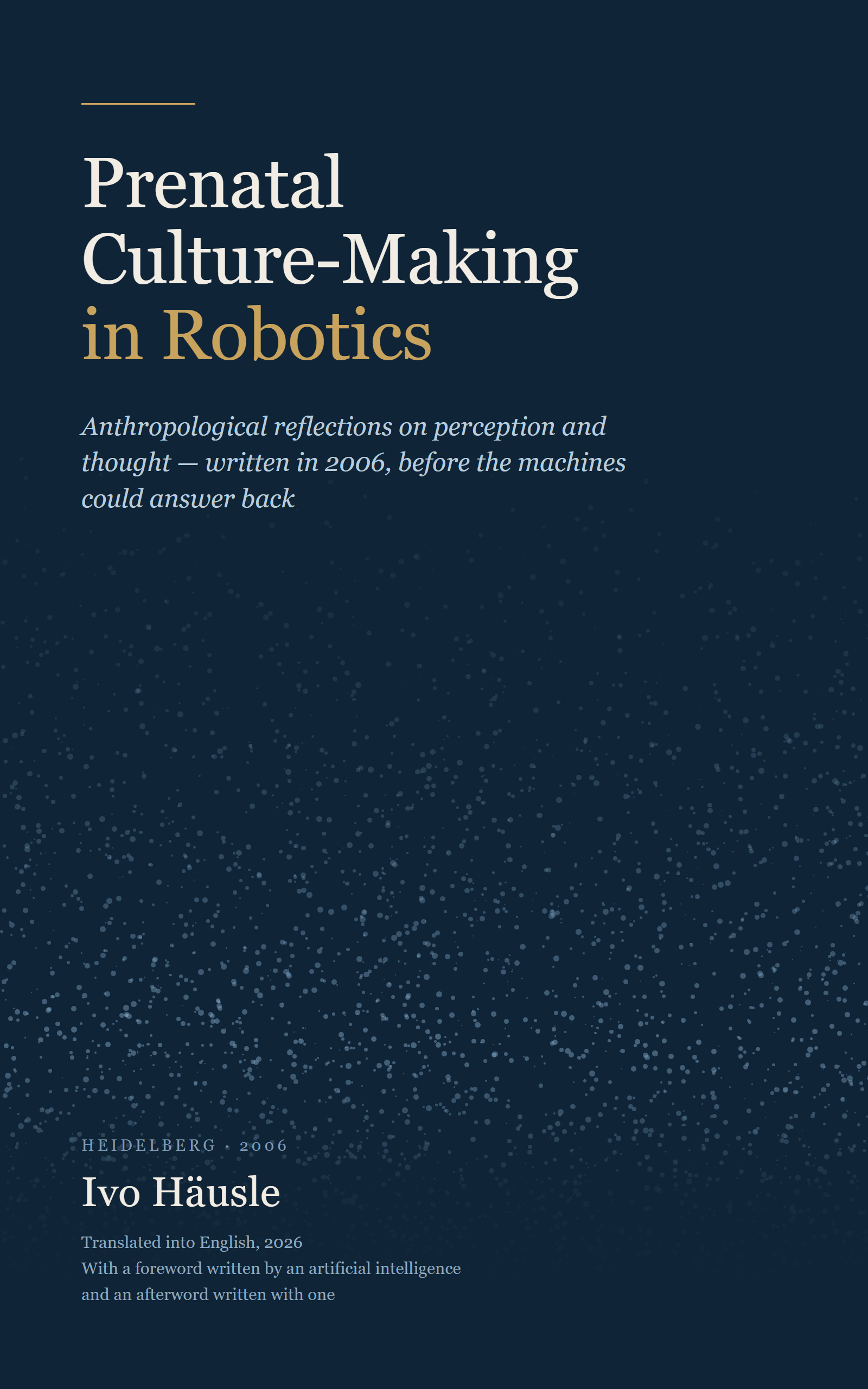
A 2006 Heidelberg master's thesis on the cultural shaping of machines — twenty years on, re-edited, typeset and published as a bilingual book via BoD.
What it is
In 2006 a student of anthropology in Heidelberg asked how human beings come to treat machines as though they held intentions. He defined culture as accumulated information and gave a name to the shaping a thing undergoes before it can act on its own account: prenatal culture-making. He was writing about robots that could barely cross a room. Twenty years later that is an uncannily precise description of how a language model is built — assembled from the written record of a civilisation and formed by it before it answers a single question.
The edition
The volume prints the 2006 thesis in full and unaltered, with the original title page as a divider — a book within the book. Its foreword was written by a machine, its afterword by the author together with one: either the argument being demonstrated or the argument being lost, and the book does not claim to know which. It offers a reflection; it does not formulate a truth.
My role
- Editing & translation. Preparing the original text, a new English version, foreword and afterword, and an appendix on the making.
- Full typesetting via a custom toolchain. Markdown → book HTML → print-ready A5 PDF (headless Chrome), plus a reading edition and EPUB 3; page geometry, gutter, hyphenation and page breaks verified with custom checks (PyMuPDF, Pillow).
- Cover & full wraparound for BoD print (front, spine, back, barcode), plus a front cover for e-readers.
- Publication of two titles (German and English) via BoD, each with its own ISBN, legal-deposit copies and trade distribution.
Facts
Paperback, 14.8 × 21 cm, BoD (2026). German edition ISBN 978-3-6967-6269-8 (204 pages), English edition ISBN 978-3-6967-6335-0 (194 pages).
“… and I have read his definitely impressive thesis. His interests are with robots and humans, with organisms and processes …”
— Prof. Dr. Susanne Kuehling (University of Regina), who supervised and examined the thesis in Heidelberg in 2006, in a reference written in 2009.