 Apimanufaktur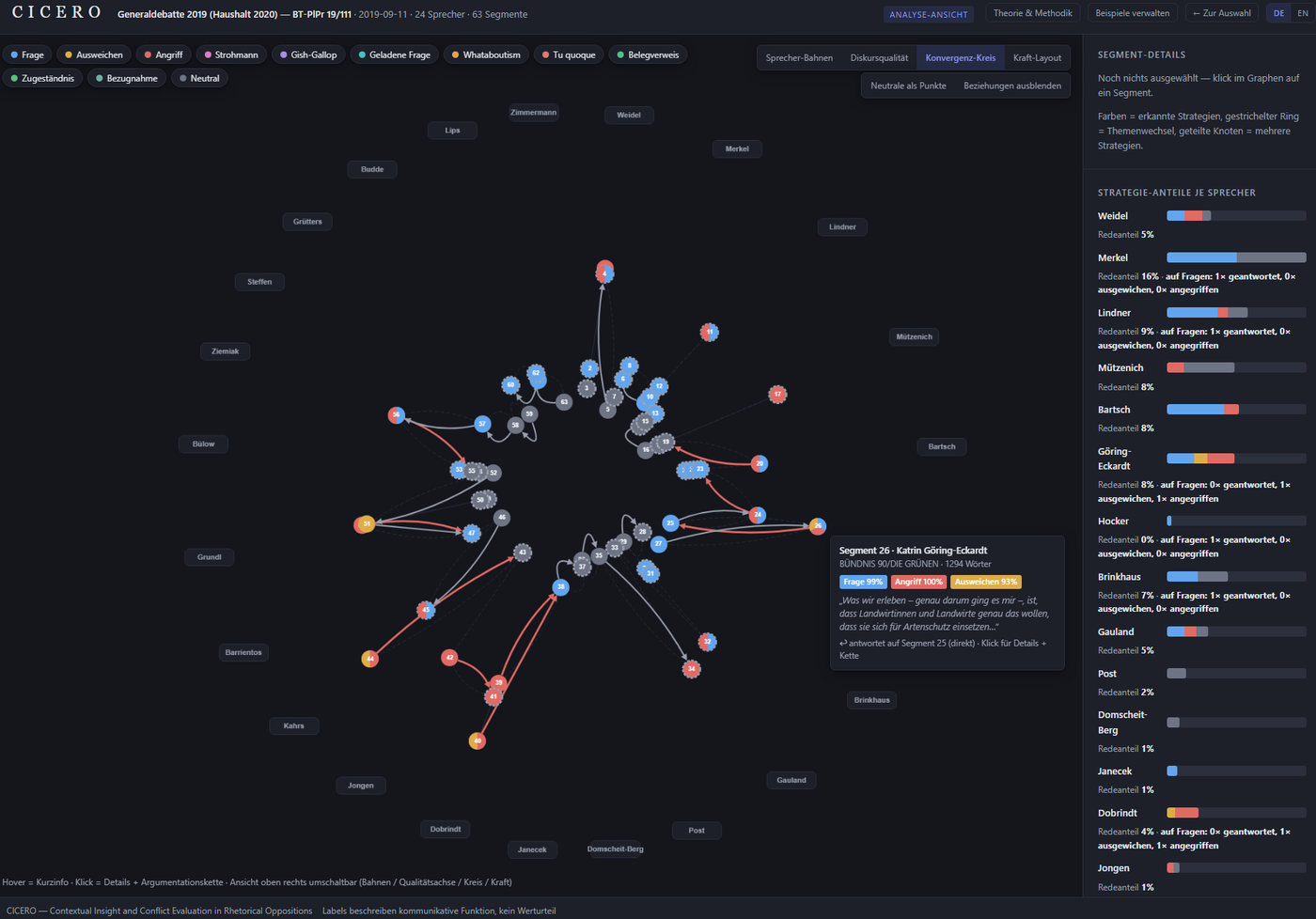
A modular pipeline that reads a political debate transcript, labels the rhetorical move behind each turn — question, deflection, attack, straw man, Gish gallop, whataboutism, tu quoque, loaded question, plus constructive markers — and links the statements into a typed, explorable graph.
| | | | ------------- | --------------------------------------------------------------------- | | Live | — (deployed behind a login; review access on request) | | Source | — (private — a commercial product) | | Concept | Jan Häusle (original idea) | | Role | Implementation solo — architecture, NLP/LLM detectors, graph, backend, React frontend, CI/deploy | | Stack | TypeScript · Node/Fastify · Graph DB (Apache AGE) · React/Cytoscape · LLM | | Status | Core concept complete · pipeline proven end-to-end, deployed, review-gated |
The challenge
Built on an original concept by Jan Häusle; implemented by Ivo Häusle. The idea: political debates are full of moves — dodging a question, attacking the person, flooding with weak points (a "Gish gallop"), changing the subject — that a reader feels but rarely pins down. The challenge was to turn that intuition into something a machine can surface honestly: segment a raw transcript, name the rhetorical function of each turn without passing moral judgement, and connect who is responding to, contradicting or supporting whom — then make the whole structure explorable rather than a wall of text. Doing it credibly meant crossing several disciplines end to end: transcript ingestion that survives messy real-world data, NLP/LLM detectors that are precise rather than trigger-happy, a graph data model, and a frontend that makes the analysis legible.
``mermaid flowchart LR In["Transcript (JSON / full-text)"] --> Ing["Ingestion · fault-tolerant, warnings-as-data"] Ing --> Seg["Segmentation · embedding-based topic-shift detection"] Seg --> Det["Strategy detectors (plugins) · rule-based + open-weight LLM"] Det --> Rel["Relationship analysis · responds-to / contradicts / supports / topic-shift"] Rel --> Graph["Typed graph store"] Graph --> GUI["React + Cytoscape explorer"] Graph --> Exp["Export · JSON / GraphML"] ``
The approach
- A five-stage pipeline behind clean seams. Ingestion → segmentation → strategy detection → relationship analysis → export, as a TypeScript monorepo (
shared/pipeline/web). External systems (graph DB, embedding model, LLM, HTTP framework) sit behind adapters, so swapping a vendor touches one adapter, not the core. - A plugin architecture for detectors. New rhetorical detectors are added through a single
StrategyPlugininterface without touching the core. The question detector is rule-based; the rest run on an open-weight, Ollama-compatible LLM with confidence scores and context rules — deliberately tuned for precision (guards against false positives) rather than eager labelling. - A growing, sourced label set. Beyond the first five strategies (question, deflection, attack, straw man, Gish gallop) the detector set now covers whataboutism, tu quoque, and loaded-question / biased framing — plus the first constructive markers (evidence reference, concession, acknowledgement), so the analysis is not purely about bad-faith moves.
- A typed relationship graph. Statements are linked with content verification and typed edges (responds-to, contradicts, supports, topic-shift) and persisted in a graph store; embedding-based topic-shift detection (BGE-M3) drives segmentation and relationship reassignment.
- An explorer, not a report. A React + Cytoscape GUI renders the annotated debate as an interactive graph with a colour legend, a sourced theory-&-method glossary, in-app speaker and example management, and force-directed de-tangling of dense graphs.
- Legally clean data by design. The demo corpus is built from public-domain German Bundestag plenary records (§ 5 UrhG) plus one US presidential debate — chosen so the shipped product carries no rights baggage, with sources named and only analysed excerpts committed.
- Real test and CI discipline. CI runs typecheck, unit tests, integration tests against a real graph database, and a license gate (permissive-only, findings recorded in ADRs); the pipeline has been run end-to-end against a live local LLM, not just statically checked.
The result
- A working end-to-end system: a debate goes in, an annotated typed graph comes out, rendered as an interactive Cytoscape view in the browser — all detectors firing against a live open-weight LLM.
- Deployed and review-gated. The frontend is live at a private URL behind HTTP Basic Auth; the Fastify backend runs on a dedicated machine and is reachable over a Tailscale funnel, with a single end-to-end login chain (browser → Vercel edge → backend) verified.
- Substantial, honest engineering documentation: a PRD (~35 user stories), 16+ ADRs recording the decisions and their rejected alternatives, and a documented set of real-world input limitations (diarisation noise, missing speaker labels) that the ingestion handles as warnings-as-data rather than crashes.
- A truthful "today vs. roadmap" split: shipped today is the core pipeline, the detector set and the explorer; on the roadmap are a gold-annotated accuracy corpus, further GUI views (quality axis, convergence view), debate comparison, and English as a fully second language.
What this demonstrates
- Interdisciplinary breadth owned end to end: applied NLP/LLM (precision-tuned detectors, prompt engineering), graph data modelling, a clean pipeline architecture, a React/Cytoscape frontend, and CI/deployment.
- Comfort with genuinely hard, fuzzy problems — labelling rhetorical function without moralising, surviving messy real-world transcripts — not just CRUD.
- Architecture-first, decision-driven work: adapters and plugin seams, configuration over hard-wiring, and an ADR trail that shows why, not just what.
- Legal and licensing care suited to a commercial product: public-domain source data, a permissive-only dependency gate, sources named.
- Modern, AI-assisted delivery, steered and curated by a human — turning someone else's sharp idea into a polished, documented, deployed product.
Tech at a glance
TypeScript · Node / Fastify · Apache AGE (graph DB) · Embedded graph store · LLM (Ollama-compatible, open-weight) · BGE-M3 embeddings · React · Cytoscape · Vite · Docker · CI (GitHub Actions) · Tailscale funnel